I'm Writing This from a Yurt
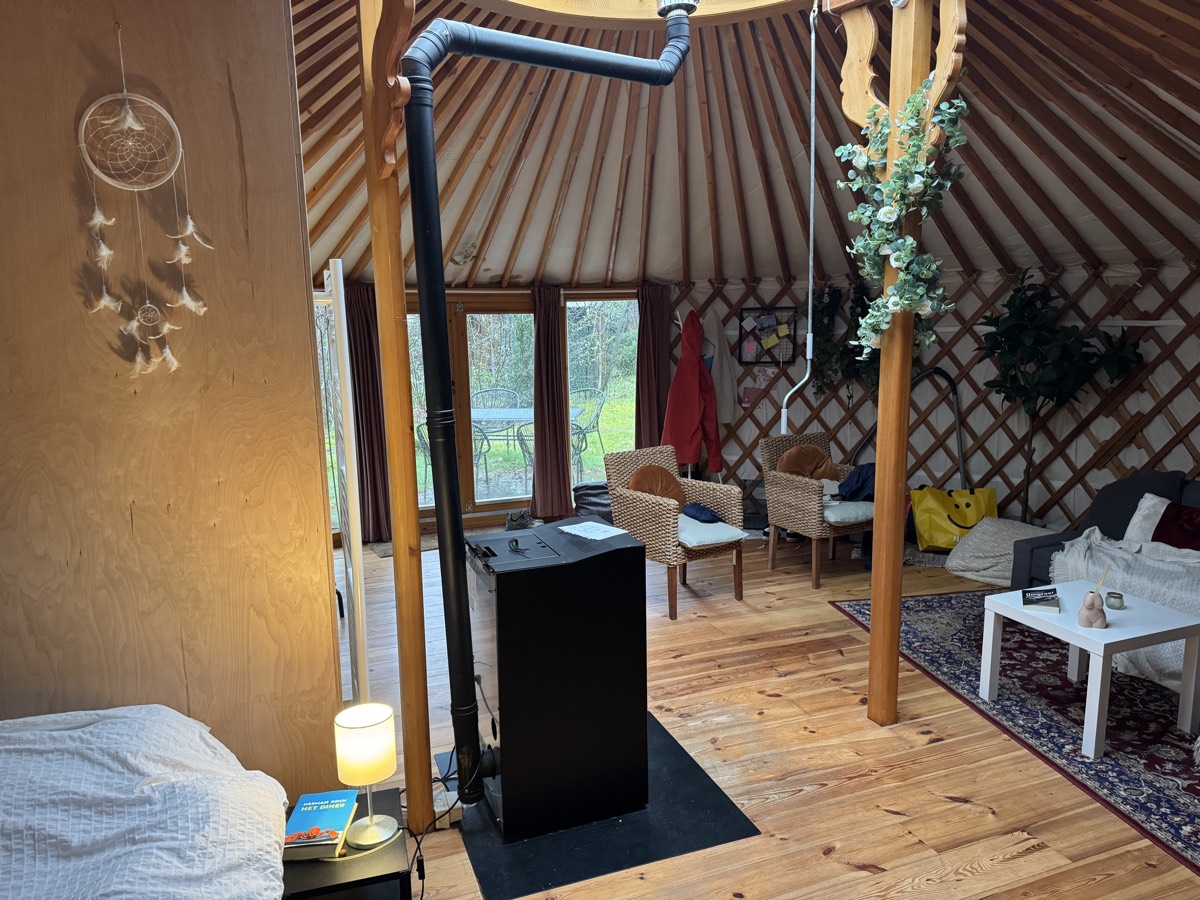
I'm sitting in a yurt in the middle of a Dutch forest. There's a wood chip stove in the corner. A bed, a couch, a skylight dome in the ceiling. Outside, the birds haven't stopped all morning.
I came here to read. Maybe think. Take a few days away from the city.
What I didn't expect is how much space there is. The yurt is not large by any measurement. But because it's round, because there are no corners eating into the room, because the walls curve instead of stop, it feels open. I've been in apartments twice this size that felt half as spacious.
The park has everything I need. The stove heats the space within minutes. At night, I can see the stars through the dome above my bed.
That thought keeps coming back: I have everything I need.
396,000
That's the housing shortage in the Netherlands right now. Nearly 400,000 homes that should exist but don't. The government set a target of 100,000 new homes per year. In 2025, about 80,000 were built. The math doesn't work.
The average house price in the Netherlands crossed half a million euros for the first time at the end of 2025. A fully equipped yurt costs somewhere between a tenth and a twentieth of that. The gap is absurd.
The waiting list for social housing in some cities stretches beyond a decade. Young people can't buy their first home. The conversation about solutions is always the same: build faster, build denser, build higher.
More concrete. More boxes. Stack them up.
What if we also looked sideways?
I'm not pretending yurts solve the housing crisis. They don't. Families need schools nearby. People with disabilities need accessible homes. The shortage is structural, and structural problems need structural answers.
But not everyone needs the same thing.
Some people need a place for a year while they figure out what's next. Some people actively want to live smaller. Some just want what I have right now: a quiet place outside the city to retreat to when the noise gets to be too much.
The Netherlands has forests. It has nature reserves, room between towns, corners of the landscape that aren't being used for anything. The question isn't whether there's space. It's whether we can imagine using it differently.
The rules weren't written for circles
This is where it gets stuck. Dutch zoning law (bestemmingsplan) determines where people may live. Building codes (Bouwbesluit) determine what qualifies as a dwelling. A yurt, technically, needs to meet most of the same requirements as a concrete apartment: insulation values, fire safety standards, structural calculations designed for rectangular buildings.
Some of that makes sense. Fire safety matters. But the framework was built for one shape. Everything that doesn't fit gets treated as an exception. Something temporary. Something to tolerate, maybe, but not to encourage.
The new Environment Act (Omgevingswet), which took effect in 2024, gives municipalities more flexibility to set their own rules. A few are starting to use it. Almere organized a competition for innovative tiny house and yurt concepts and created a permanent project for them. Minister Keijzer is working on new rules that would allow people to stay in recreation dwellings for up to ten years. Things are moving, slowly.
But most municipalities haven't moved at all. The default remains: if it doesn't look like a house, it doesn't count as one.
Omdenken
There's a Dutch concept I keep thinking about: "omdenken." Thinking around a problem. Looking at it from a direction nobody tried.
We have a crisis. We can't build fast enough. But what if not all 400,000 missing homes need to be homes in the traditional sense?
What if some of them are yurts in forests? Tiny houses on unused land? Structures that are warm, safe, and dignified, just not rectangular?
What if building codes had a lightweight category for small dwellings, with simpler requirements that still keep people safe? What if municipalities designated zones for alternative housing, the way some already do for houseboats?
None of this replaces the need for regular homes. But it creates breathing room while we build them. And for some people, it's not a compromise at all. It's a preference.
The dome
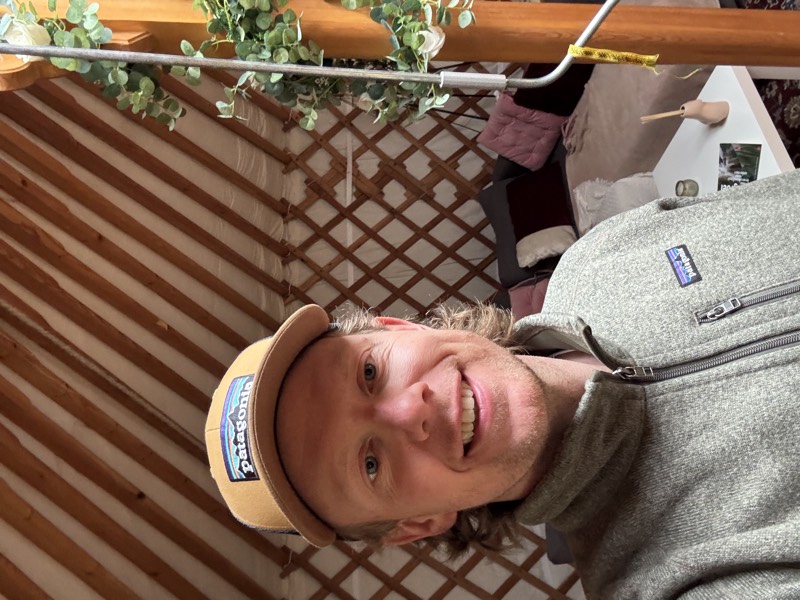
It's quiet now. The stove is warm. Through the dome above my head, I can see the sky.
I don't think I'd want to live here permanently. But as a place to go when I need to think, when the city feels like too much, when I need to remember what quiet sounds like? This is better than any apartment I've rented.
396,000 homes short. And we're only counting one shape.
If you want to know when I write something new: