One David, Two Goliaths
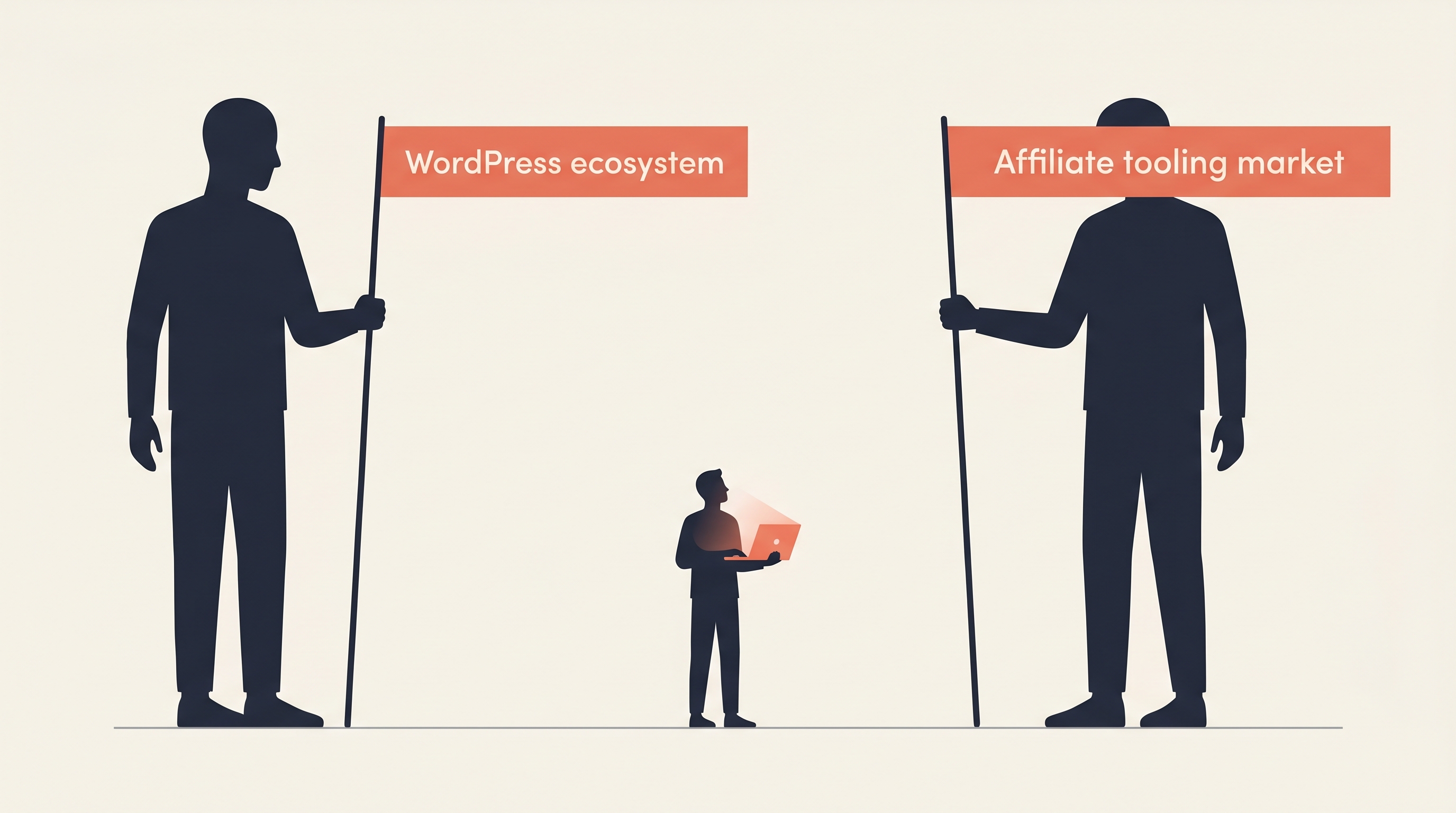
I'm working on two things right now.
SailWP, a WordPress theme that's trying to make Priscilla's life on the web a little less awful. And LinkPulse, an affiliate link intelligence tool that surfaces the slow revenue leak nobody else surfaces. Both products work. Both have the kind of small bugs you only catch by living inside them every day, which is what I'm doing.
I should probably only be working on one.
Every founder essay I've read says the same thing. Focus. One thing. Until it's working, until it's growing, until you have a team behind it. Then maybe a second one. Maybe.
I'm doing two anyway. I want to write about why, what I'm noticing about it, and then ask for help.
The framing that keeps clarifying things for me is blue ocean and red ocean. It's not new, it's from a 2005 book, but it maps onto what I'm doing in a way that most generic founder advice doesn't.
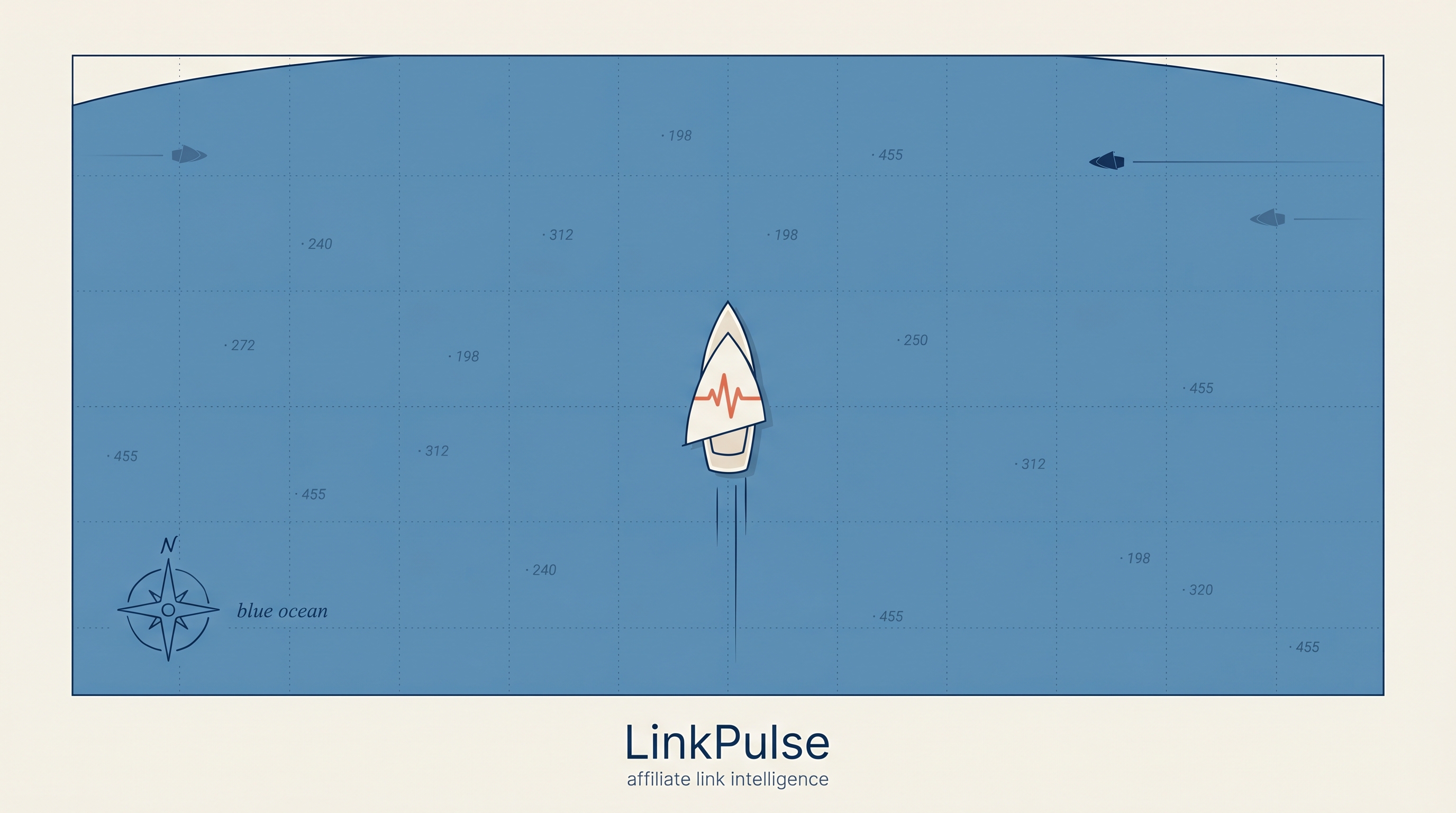
LinkPulse is in a blue ocean. There is no product on the market that does what it does. The closest things are Skimlinks and Sovrn, which are JavaScript snippets from 2012 that take a cut of your commissions in exchange for handling affiliate logic. Useful in their moment, the wrong shape for now. There are some thin scanners and a couple of MCP experiments. Nothing that watches your affiliate links, understands the networks, quantifies the leak in real money.
I've written before about what's actually broken in this market, why the publishers feel the loss first, and the longer arc of why three different parties all lose at once. The short version: an entire layer of web infrastructure is missing, and nobody owns the fix.
The blue ocean sounds like the easy side. It is not.
When you're alone in open water, nobody is sailing toward you because nobody knows there's a destination here. People haven't named the problem yet. Publishers know their links break, but they think of it as one of those things, like dust. You have to teach the category. You have to show them the leak, give it a name, quantify it, and only then does anyone reach for the wallet. That work is education work, and education work is slow.
I knew this in theory. I'm finding out what it feels like.
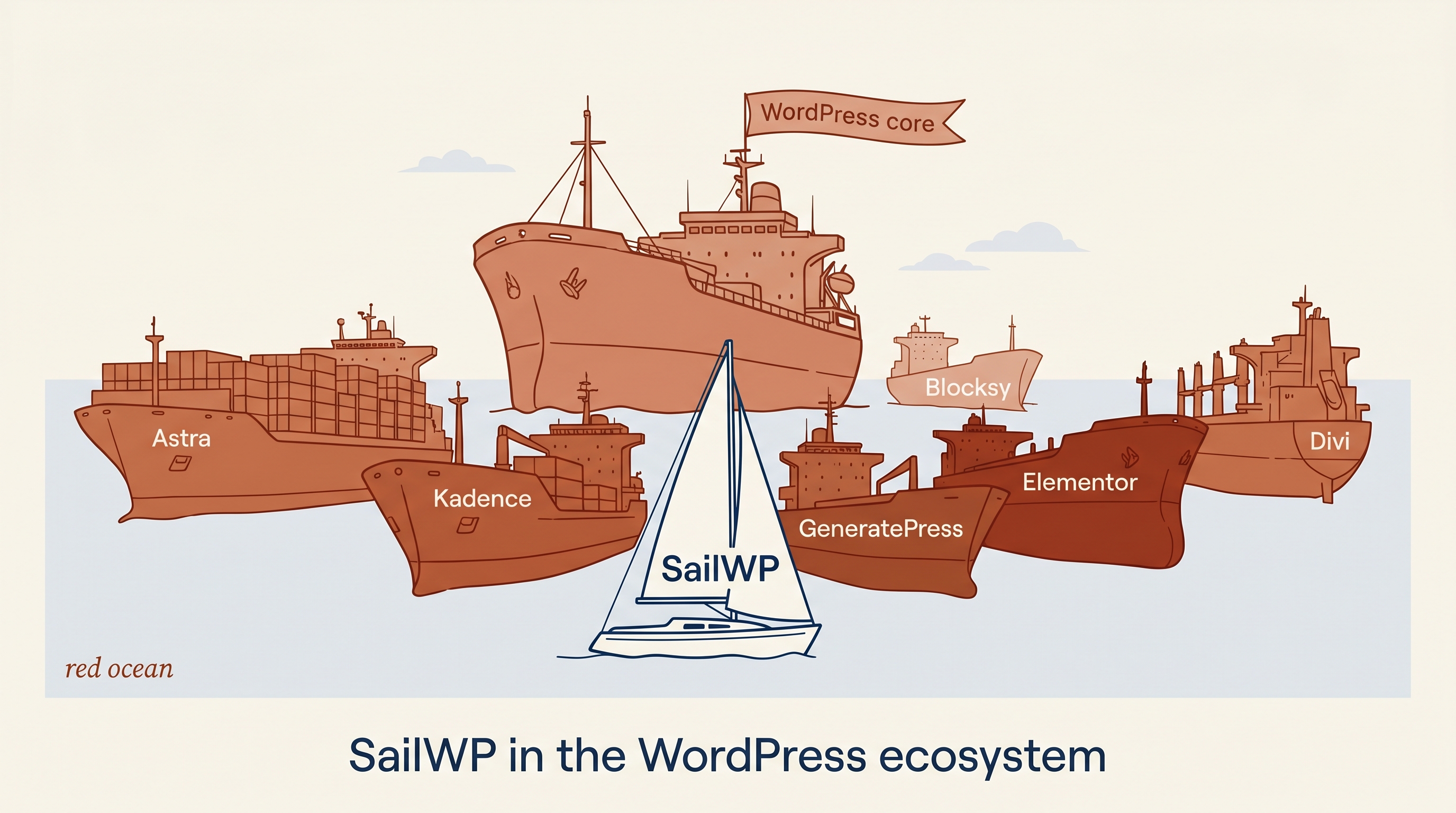
SailWP is the opposite problem. Red ocean. WordPress is twenty-three years old. Astra, Kadence, GeneratePress, Blocksy, Elementor, Divi: they've all been at this for a decade or more, with thousands of contributors, real revenue, mature teams. There is no shortage of WordPress themes. There is no unmet need that everyone agrees on. Every problem has been claimed by someone, and they will defend that claim.
The thing is, none of them are solving what I'm solving. I've written about why WordPress doesn't need a fork, it needs a spine, and about the day Priscilla gave up trying to update her own site from her phone. SailWP bakes SEO, security basics, performance, and the things you'd normally install eight plugins for, straight into the theme itself. Then it adds a Co-pilot that lets you talk to your site instead of clicking through Gutenberg on a six-inch screen.
That's not a feature the big themes are going to bolt on tomorrow. The Co-pilot took months to get right. It works now, well enough that I'd recommend it to my friends. But "well enough to recommend to your friends" and "well enough to peel customers off Astra" are two different bars.
In a red ocean, you can't just be different. You have to be different in a way the market already recognizes as valuable, or you have to be different long enough that the market learns to recognize it. Both are expensive in time and patience.
So that's the asymmetry. Two products, two completely different markets, two completely different kinds of hard.
Blue ocean: I have no competitors but I also have no awareness. I have to build the category before I can sell into it.
Red ocean: I have all the awareness in the world but I'm one new option among hundreds. I have to be visibly, undeniably better at a specific thing, for long enough that people switch.
Either one of these is a full company on its own. I'm doing both, at the same desk, with the same brain.
I'm aware of how this sounds. There are people who've taken on two things at once and made it work. A handful of solo founders have run multiple products in parallel without it ending in a quiet collapse. What they tend to have in common: a team they can lean on, investors who pay them to think in years, or a previous exit that funds a long runway.
I have none of those. No team. No VC. No big bank account. I come into the field carrying a laptop and a working knowledge of Claude Code, and that's about it.
I think a lot about what I do have. I have the products. They both work, today, with their kinks, but they work. I have a strong sense of who I'm building for, on both sides. I have time, in the sense that nobody is forcing me to ship in the next quarter or starve. I have a small reach through Start24 and through this site. And I have what I believe is a real competitive edge: I'm one of the better people on earth at using AI as a co-builder.
That isn't a brag. It's just true, and worth noting because it changes the math. The reason two products are even thinkable as a one-person project in 2026 is that what a single person can do has shifted. What used to take a team of five takes one person and a good co-builder. The constraint moves from "can we build it" to "can we judge what to build, sell it, and not collapse under the operational weight."
That last constraint is where I am most likely to break. Building is the easy part now.
The David framing isn't a stretch. One person, working alone, with no obvious structural advantages, taking on two markets that are each large enough that getting any meaningful piece would mean a company worth tens of millions. The size of the markets isn't speculation. WordPress runs 43% of the web. Global affiliate marketing is a twenty-billion-dollar-a-year industry. The math on what these can become, if they work, isn't subtle.
The math on what they cost, if they don't, also isn't subtle. The cost is years of my life and the opportunity cost of every other thing I could have done with them.
I'm going to do it anyway. I'm aware that's also exactly the thing every overconfident founder says. I have no good answer to that. I just believe in both of these products enough that I can't make myself not try.
What I'm hoping this essay does, beyond letting me think out loud, is reach the small number of people who've actually done some version of this. Built two things in parallel. Or built one big thing without a team or a war chest. Or watched someone do it up close and saw what made it work, or what made it fall apart.
If that's you, I'd like to talk. Not as a customer. As someone trying to learn from people who've been in the room before. How do you protect your time? How do you tell a real signal from noise that's just demanding your attention? How do you avoid the failure mode where both projects get 50% effort and neither lands?
My email is [email protected]. I read every message. If you want to spar about strategy, time management, or tell me I'm being an idiot and to pick one, I'm all ears.
I don't know how this is going to go. I know that as I'm writing this, both products are running, both have users, both have problems I'm going to spend tomorrow fixing. Everything I'm describing is in motion, not theoretical.
It might work. It might not. The interesting thing about being the David in this picture is that the giants don't have to do anything in particular to win. They just have to keep being giants. I'm the one who has to do something different from what's expected of someone in my position.
That's the part I find clarifying. There is no version of this where I win by being slightly better at the thing the giants are already doing. I have to do something they aren't going to do.
For LinkPulse, that means building the missing infrastructure for an industry that's never had it, and patiently teaching publishers that the leak they've been ignoring is real.
For SailWP, that means making WordPress feel like 2026 for the people the rest of the ecosystem treats as a marketing afterthought.
For me, it means trying to be one of the rare cases where one person, with leverage and patience but not much else, builds two things at once and doesn't break trying.
Talk to me if you've done this. I have a lot of questions.
If you want to know when I write something new: